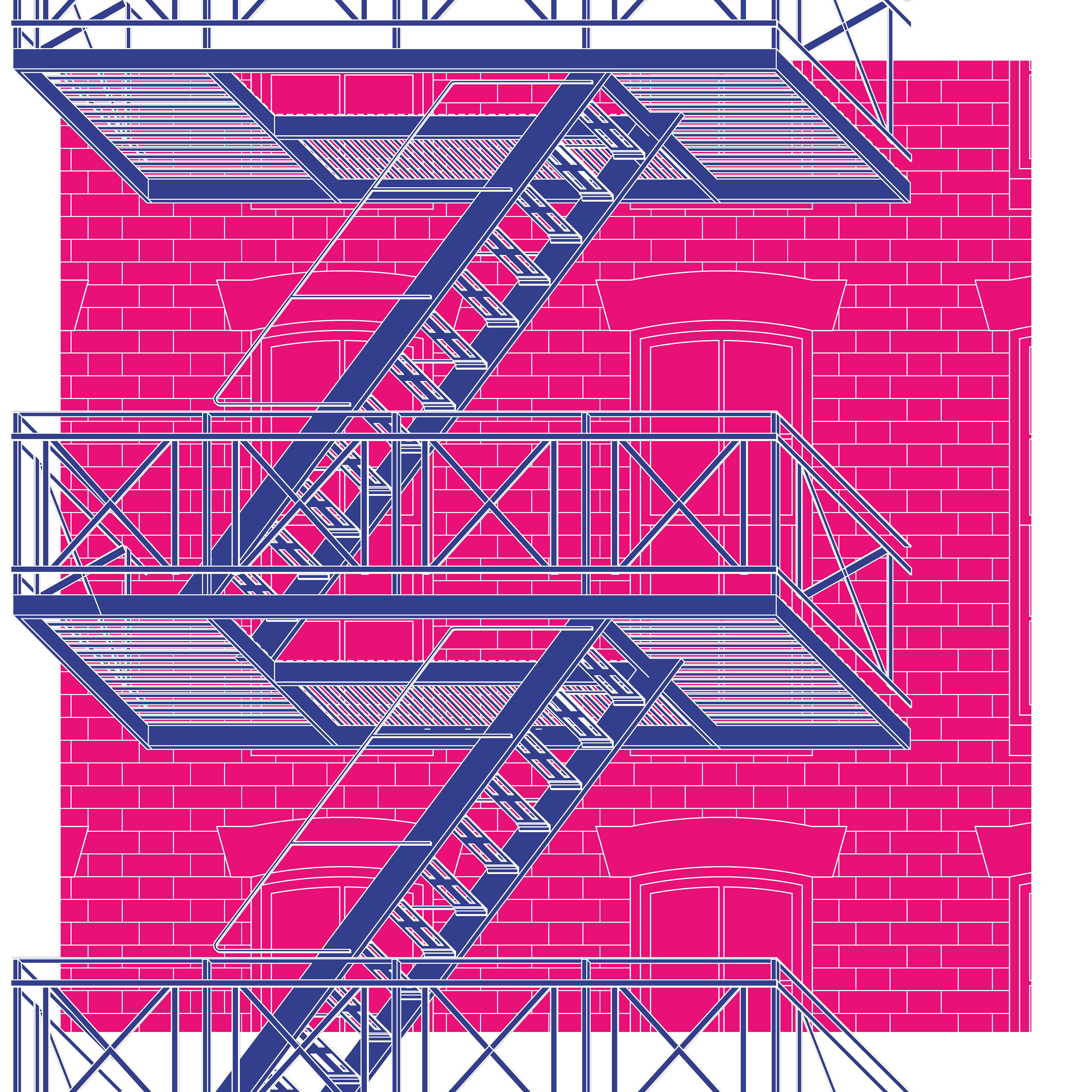
Breaking the Wall: Learning from the Fire Escape
TBD
The fire escape is one of the architectural emblems of New York City’s urban landscape. A perfunctory invention of necessity, its reiteration throughout the city’s contemporary history, spanning over a century, solidifies its status as a sociocultural symbol. Yet, the romanticization of the fire escape in media and culture has diluted its potential as a space. Given the ongoing housing crisis amidst the proliferation of luxury residential glass boxes, the space of the fire escape as a mediated threshold offers an alternative perspective on how the domestic realm could relate to the public beyond the walls of one’s apartment.
New York City is entering a new era with the election of Mayor Zohran Mamdani. With a record-low vacancy rate of 1.4%, the city is transitioning during an all-too-well-known housing crisis. While Mamdani pledged housing reform during his campaign and has already signed executive orders to facilitate housing developments, architects are notably absent from this endeavor.
Housing, an inherently architectural problem, has been rendered a domain largely devoid of architectural workers. As C.G. Beck, a licensed architect and organizer who formed the first private-sector architecture union in the US, noted, “We shouldn’t be surprised that architects were left out, but we should be concerned.” This absence raises a fundamental question: What has architecture ceded in its withdrawal from housing as a social and civic task?
Despite this decline in housing, recent decades have seen the upsurge of setback high-rise residential glass towers. These buildings, which writer Francis Northwood describes as blighting much of new construction, and which social media influencer Ben McClintock mockingly dubs “Temu Towers,” have come to dominate the contemporary skyline. Clad in reflective, floor-to-ceiling windows, these pristine luxury towers stand as a material testament to the divisive socioeconomic inequalities between those who can afford them and those who cannot. Their surfaces are materially transparent yet visually opaque; the window becomes a wall. In this way, the façade establishes an us-and-them dynamic, transforming the building envelope into not merely a physical barrier but a social one. Matthew Soules, in his critique of Rafael Viñoly’s 432 Park Avenue, observes how such towers operate less as housing for actual inhabitation than as monuments to capital. When residential architecture is shaped in the image of finance capital, inhabitation becomes secondary, if not incidental. In light of this, the architecture of housing ought to be rethought.
Rather than further pursuing novel construction technologies or reducing façade design to an optimization exercise, we turn toward an overlooked yet deeply embedded architectural element: the fire escape. Long dismissed as a romantic regulatory appendage, the fire escape that has defined New York City’s urbanity may offer an alternative model for thinking about housing and its relationship to the public realm.
Installed on countless nineteenth and twentieth-century apartment buildings, the fire escape represents the iconic cityscape of New York City, its image synonymous with the city itself. Conceived as a legally mandated second means of egress from 1867 to 1968, the fire escape nevertheless evokes nostalgia and romanticism, a sociocultural allure reinforced through decades of representation in photography, film, and literature. Although the law restricts its use to emergencies, New Yorkers have continuously appropriated this space as an extension of their dwellings, co-opting it as an outdoor living room, laundry space, or simply as a site for transient activities such as smoking or people-watching.
Beyond its cultural indispensability, the fire escape produces an ambiguous spatial condition that fundamentally alters the building façade. It operates as a semi-public space, like the vernacular suburban American porch, while being suspended in a dense urban context. In so doing, it breaches the exterior wall that unambiguously demarcates a rigid boundary between the domestic interior and the public exterior. Through its embedded stairs, the fire escape enables neighbors within the same building to reach one another, creating the potential for close physical interaction. This semi-publicness both connects and separates, allowing the façade to be simultaneously occupied, viewed, and traversed. The fire escape thus becomes communicatively effective and emotionally affective, offering a site of sociality absent from contemporary glass towers.
Through its ambiguities and contradictions, the fire escape behaves as a second façade, one that equips inhabitants with an additional domestic space that encroaches upon the public realm. It activates the space beyond the exterior wall, permitting the fenestration to be not only an aperture through which occupants can look but also an inhabitable, traversable threshold. Through its tectonic porosity and public-private ambiguity, the fire escape operates as a connective ligament, bridging the domestic life and the public realm beyond the boundary of one’s apartment. Hollie Marnitz likens the fire escape to a theater, one that acts out a play of sociality: “it offers a stage upon which social encounters can be enacted and viewed.”
Because community is fundamentally interdependent with housing, the fire escape’s capacity to make neighbors within a building and across the street, and to make passersby mutually visible, carries political weight. By allowing occupants to acknowledge one another beyond the opaque façade, the fire escape undermines the wall’s function as a device of exclusion. In this urban microcosm, distinctions between inside and outside, private and public, us and them, are destabilized. As New York City moves toward a new political era, the fire escape suggests that architectural futures might be found not only in innovation but also in reexamining the spatial capacity embedded in the city’s past.